Assess the floor
We check for lippage, cracks, grout condition and how much stone thickness is likely left after earlier work.

Temecula Custom Countertops offers marble floor resurfacing & refinishing in Temecula, CA, Fallbrook and French Valley, from cloudy etching to scuffed paths through the house. We grind the worn face of the stone, hone or polish it to the finish you pick, and seal it. The floor you already own is brought back, with no demolition and no new tile.
Get a free measure or a bid
Marble floor restoration means removing the damaged top face of the stone and letting the fresh stone beneath show. We work with diamond abrasives and water, moving from coarse to fine until the surface is flat and has the sheen you want. It also covers travertine and limestone floors.
Entries, hallways, bathrooms and kitchens are the usual jobs. The people who do the stone work on your floor are the same people who make and fit countertops, so we know how marble behaves under acid, water and foot traffic.
How we work
A free assessment at your home, then a written quote for the level of work your floor needs.
Marble is solid stone from top to bottom, so wear affects only a thin layer on the surface. Its colour and veining run all the way through, which means removing that thin layer reveals the same stone, fresh and undamaged. A painted or coated floor cannot be restored that way.
Etching is the chief villain. Acids in juice, wine, vinegar and many cleaners dissolve a little calcium carbonate from the surface, and the polished face turns dull in that spot. The stone is not stained. It is chemically roughened, and the only true cure is to take the roughened skin away.
Travertine and limestone behave in the same way, so we apply the same method to those floors. A floor like this is rarely beyond saving, and restoring it costs much less than ripping it out.
Restoration is a ladder of finer and finer steps, and skipping one leaves scratches behind. We start by looking at the floor in raking light and reading its condition, then choose the first rung that will actually fix what is wrong.
We check for lippage, cracks, grout condition and how much stone thickness is likely left after earlier work.
Coarse diamond pads remove deep scratches and level uneven tiles, and every pass is rinsed and inspected.
Finer pads erase the scratch pattern of the coarse ones and leave a soft matte surface.
The finest pads bring up a reflective face, if you want a glossy floor rather than a matte one.
A honed floor is matte and a polished floor is glossy, and both are real finishes cut into the stone. Neither one is a coating that will peel off in a year.
Honed marble is the practical pick for bathrooms, entries and busy family rooms. It hides etch marks well, because a dull spot on a dull surface hardly shows, and it feels less slippery when wet. Many owners also like its calm, modern look.
Polished marble is brighter and more formal. It shows off veining and reflects light, which suits a foyer or a dining room that does not see heavy daily use. The price of that shine is that every etch mark and scuff catches the eye.
Temecula homes get a lot of sun through large windows, and a polished floor throws that light back across the room. A honed floor takes the glare down. If you cannot decide, we leave a sample patch in a corner and let you look at it in the morning and the afternoon before we do the whole room.
Grinding removes surface damage, but chips, cracks and holes need filling before the final passes. We fill them with a colour-matched epoxy, let it set, then grind and polish it flush so the repair blends into the stone around it.
Grout is another part of the job. Where the old grout is cracked, stained or missing, we rake it out and replace it, because fresh grout between freshly refined tiles is what makes a floor look finished. A matched grout colour keeps the joints from drawing attention.
We are honest about limits. A crack caused by movement in the slab below will often return, and covering it again does not cure the cause. A floor that has been ground several times in the past may have too little material left for another deep pass. We check thickness and tell you what is realistic before you agree to anything.
Underfloor heating, a thin setting bed or an old repair can all change the plan. We would rather adjust the approach at the assessment than discover the problem halfway across your hallway.
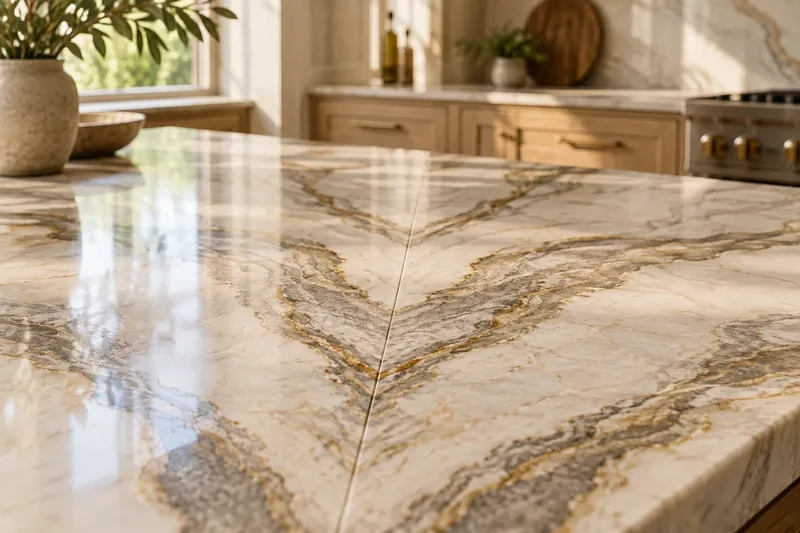
Sealing is the last step and the one that protects the work. An impregnating sealer soaks into the stone and fills its pores, so spills stay on the surface long enough to wipe away. It does not leave a shiny film, and it does not change the colour of the floor.
Hard water matters on bathroom floors. Temecula water carries about 230 mg/L of hardness, according to the Rancho California Water District, and it leaves white mineral rings around a tub or a shower threshold. Those marks wipe off a sealed floor far more easily than they do off a bare one.
We show you the routine on the last day and explain when to call us. A well kept floor usually needs only a light polish touch-up after several years, and reseal timing depends on how much water and traffic it sees.
Marble floor restoration is generally estimated at about $4 to $9 per square foot for a hone-and-polish job, and a floor needing a full flattening pass often runs $6 to $12 per square foot. It is usually far cheaper than tearing out and replacing stone.
These are estimates, and your floor may land outside them. We confirm the real number in a written quote after looking at the stone and measuring the rooms, and we never start before you have approved it.
The work is wet, not dusty. Grinding uses water to cool the diamonds and carry away the fine slurry, which we contain and pick up as we go. Furniture in the work area is moved, doorways are protected and adjoining rooms stay clean.
Most rooms take a day or two, depending on size and how much correction the stone needs. After the final pass the floor must dry before it is sealed, and then it needs a short cure before regular traffic. We tell you how long to stay off it when we set the schedule.
You will notice the difference as soon as the first pass dries, because the stone looks like a different floor under the same light. We check the result with you in morning light, since that is when flaws show, and fix anything you spot before we leave.

The process
We look at the floor before we quote, and we test the finish where you can see it before we do the whole space.
Describe the floor, the rooms and what is bothering you, and send a few photos if you can.
We visit, check the stone, the grout and the tile edges, and talk through honed and polished.
The crew works up through the abrasive grits, fills any chips and refines the surface room by room.
We seal the stone, clean up and show you how to care for it so the finish lasts.
Questions
In most cases it will. Marble is uniform through its depth, so taking off a thin skin uncovers clean stone, and the etching and light scratching go with it.
Almost always. You skip demolition, disposal and new tile, and you keep the original stone, which is hard to replace in an older home.
Honed is matte, forgives etching and is less slippery, so it suits baths and entries. Polished is glossy and formal, and it shows every mark.
No. The finish comes from diamond abrasives, and protection comes from a sealer that soaks into the stone. Waxes sit on top and eventually yellow or peel.
Not a lot. The process runs wet, which keeps airborne dust down, and the slurry is vacuumed up as we go. You can walk on the room again after it dries and the sealer cures.
Yes. They respond to the same grinding and honing steps, and we adjust the pads and the sealer to the stone.
A few. A floor ground many times may be too thin, and a tile cracked by movement below will crack again until that cause is fixed. We check before we quote.
Book the free assessment. We look at the stone, measure the rooms and send the price in writing, with the level of work listed.
A free assessment at your home, then a written quote for the work your floor actually needs.
Licensed, bonded & insured · License #585047. Calls only, we do not receive text messages.