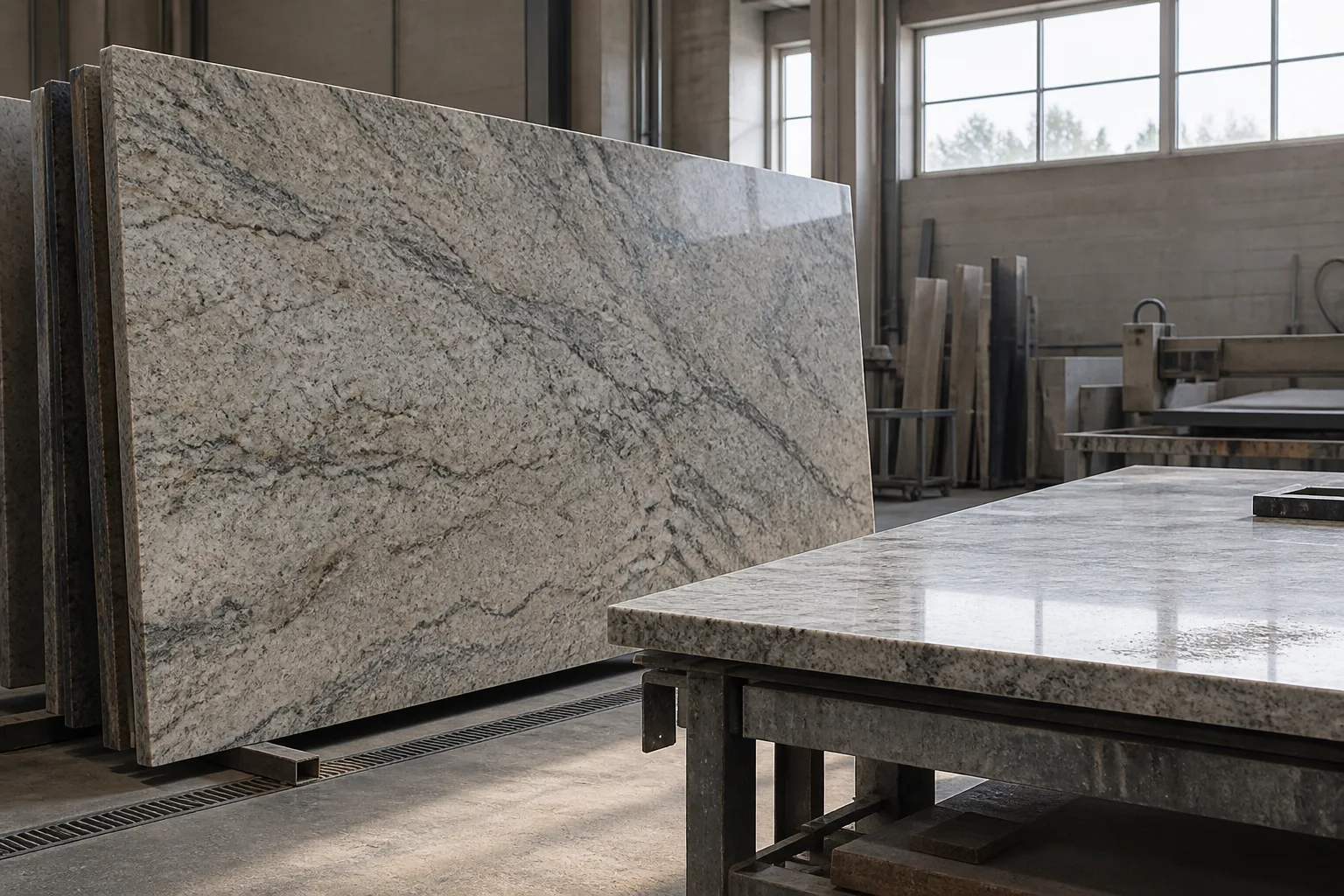
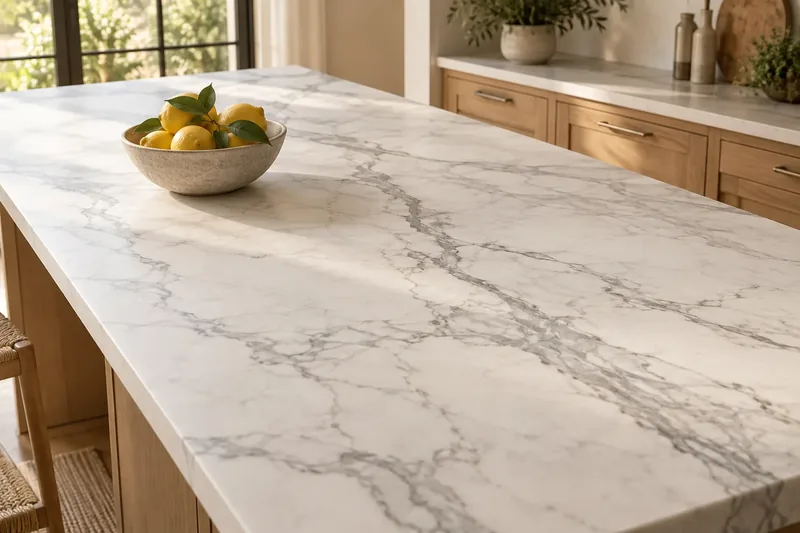
Count the length
The top, the leg and the saw kerf all come out of one slab, so we add them up against the slab length before you choose.

Temecula Custom Countertops builds waterfall edge countertops in Temecula, CA, Fallbrook and French Valley. The slab turns a mitered corner at the end of your island and drops to the floor, with the veining carried through the joint. We cut and fit the miter in our shop, so the seam is tight before the stone ever reaches your kitchen.
Get a free measure or a bid
A waterfall edge is a countertop that continues down the side of a cabinet as a vertical panel of the same stone. We build each one from a single slab where we can, cutting the top and the leg in order so the pattern reads as one piece of rock folding over the corner. The crew that measures your island is the crew that sets the stone.
Most Temecula waterfalls end up on a kitchen island facing the family room, though we also build them on peninsulas, bar ends and fireplace-side built-ins. Wherever you want one, we confirm the slab will actually yield the leg before you commit to the look.
How we work
Homeowners get a free measure. Builders and designers can send plans for a written bid.
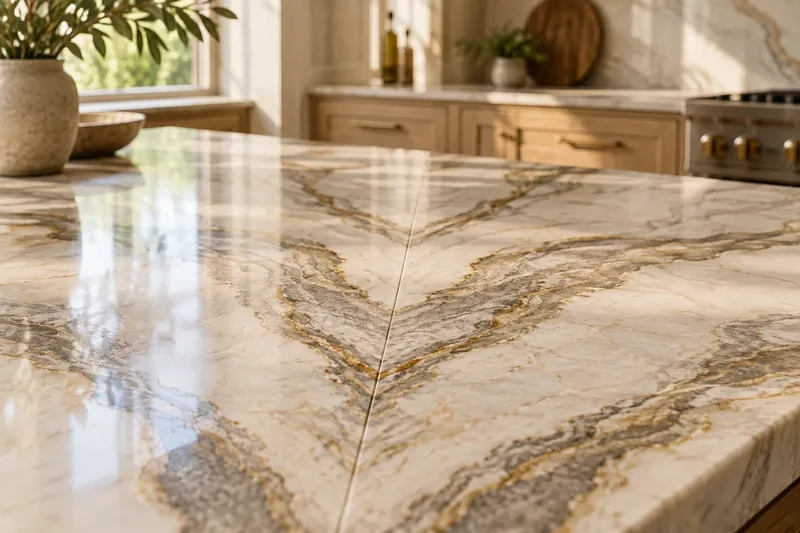
A waterfall edge is a 45 degree miter, which means the top and the leg are each cut at an angle and glued so the two faces meet at a clean right angle. Done well, the line where they meet nearly vanishes, and the grain looks like it bends around the corner.
The work starts with the slab layout. The leg is cut from a section that lines up with the top, so a vein that exits the counter surface re-enters on the vertical face. A fabricator who cuts the pieces from different parts of the slab gets a leg that does not match, and that mistake is expensive because the stone cannot be unmade.
After it cures, we polish the joint so you feel nothing under your hand when you run it across the corner. That final check is why a waterfall is shop work, not something to improvise at the house.
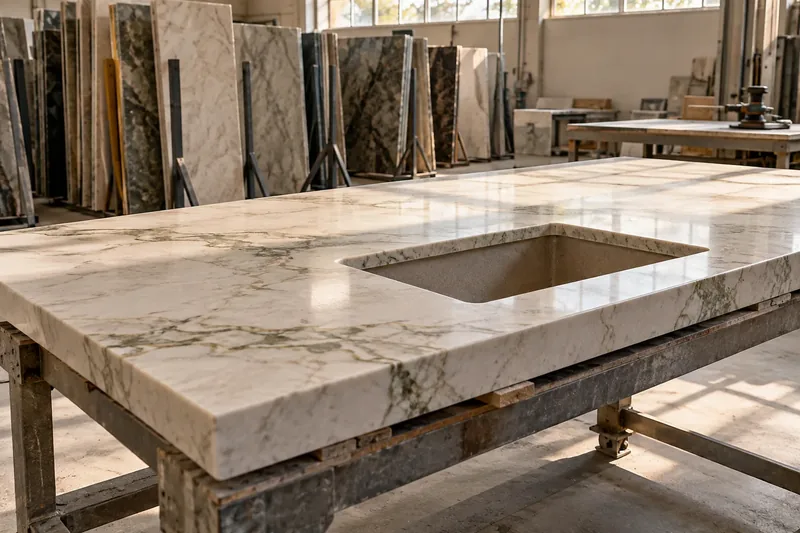
A waterfall asks more of a slab than a flat top does, because it needs length and a consistent pattern in two directions. We walk the slab yard with you and look at the stone the way a fabricator does, before you pay for anything.
The top, the leg and the saw kerf all come out of one slab, so we add them up against the slab length before you choose.
Veins that run across the slab width fall naturally down the leg, while veins that run lengthwise can stop at the corner.
Pits, fissures and colour jumps are tolerable on a flat top, but they stand out on a leg you see from across the room.
A thicker slab makes a heavier, more sculptural leg. A thinner one looks sleek but needs better backing.
The best spot for a waterfall is any cabinet end you can see from the room where people sit. On a Temecula kitchen island that usually means the side facing the living area or the patio door. A leg tucked against a wall is stone you pay for and never admire.
Newer homes in the valley often have large open islands, and those suit two waterfall ends, one at each side, which gives the island a monolithic look. A single end suits a smaller island or a tighter budget and still reads as a deliberate design choice.
If you are not sure which end to feature, we stand in your kitchen at the measure and look at sight lines with you. Where an appliance or a trash pull-out sits against the end panel, we tell you before the stone is cut, because the leg needs a clear face to look right.
Quartzite and marble make the most dramatic waterfalls, because their veining is bold and directional. A grey or gold vein that sweeps across the top and down the leg is the look most people picture when they ask for this detail.
Granite works too, especially stones with movement rather than a speckled pattern. Engineered quartz is the quiet option. Its pattern is consistent, so there is little matching risk, and a leg in quartz keeps looking the same for years. Porcelain slabs can be mitered for a very thin, crisp edge, though they ask for a fabricator who knows how to handle the material.
Marble is the one to think about carefully. It etches when acid touches it, and a vertical leg is less exposed than a top, but a waterfall island still sees lemon, wine and tomato. A matte honed surface conceals etch marks far better than a glossy one does. We tell you plainly which stone will age well in your home and which will need attention.
Hard water in Temecula leaves a pale film on dark surfaces, so a deep black stone shows more upkeep than a veined white one. We would rather you hear that at the slab yard than after install.
A waterfall leg is heavy, and it has to stay still for decades. A slab of stone a few centimetres thick weighs far more than it looks, so the leg gets a proper backing and a plan for how it sits on the floor.
On an island, we template the cabinet end and note whether the floor is level where the leg lands. Floors in many houses are slightly out, and a leg cut to a perfect rectangle will rock if the floor is not. We scribe the bottom to the floor where needed, or we plan a small reveal at the base so the stone sits true.
The top rests on the cabinet frame, and the corner joint carries a hidden support so the miter is not carrying the load alone. Where an overhang extends for seating, we add steel or a plywood sub-frame to the plan, because stone cracks at an unsupported span.
Install day is calm when the prep is right. Two or three people carry the leg in, set it on shims, check it with a level and bond it to the cabinet. Then the top lands, the miter is closed and the joint is cleaned and polished. We protect your floor with pads and take the packaging with us when we leave.
A waterfall edge is usually estimated at about $900 to $3,500 added per exposed end, on top of the price of the island top. The slab you choose moves that figure more than anything else, because the leg uses a full section of material.
Those numbers are estimates only. The written quote sets the final price after we measure your island and confirm the slab will yield a clean leg. Nothing is ordered or cut until you sign off on it.
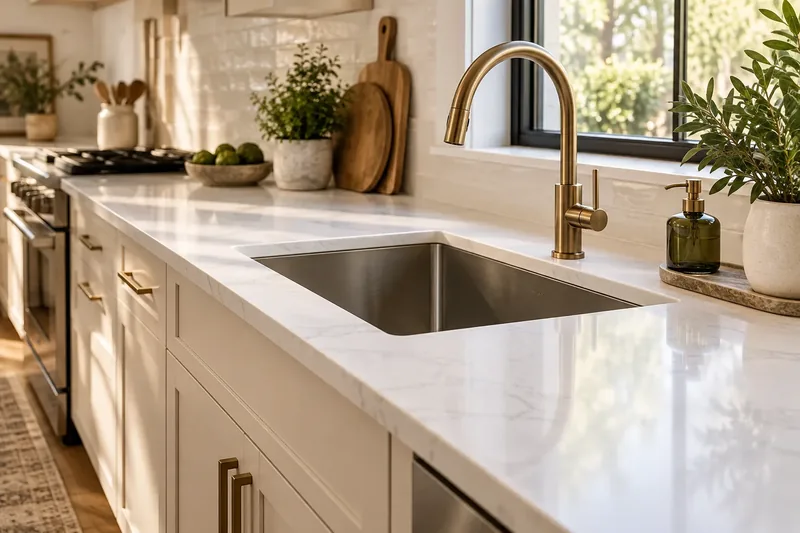
A waterfall island wants the same light routine as any natural or engineered stone surface. Wipe spills before they dry, use warm water and a soft cloth, and dry the area around a sink to keep mineral spots from forming.
Natural stone needs a sealer, and we apply an impregnating one that soaks in rather than leaving a film. Test it with a few drops of water once a year. If they bead, you are fine, and if they darken the stone, it is time to reseal.
The leg takes scuffs from shoes and vacuum cleaners at its base, so keep an eye on that corner. A scuff on polished stone often wipes off, and a small chip can be repaired. Tell us if you find one and we will say whether it needs a visit.
The process
No stone is cut until you have seen the slab and approved where the leg and the seams fall.
Tell us about your island, and send a photo if you have one. Builders and designers can send plans for a bid.
We meet you at the supplier, check the yield for the leg and mark the layout on the slab for your approval.
We measure the cabinets and floor, then cut, miter and polish the top and leg in the shop.
The same crew carries in the leg, sets the top, closes the miter and cleans up before leaving.
Questions
It is a countertop slab that continues down the side of a cabinet to the floor. The top and the leg meet at a mitered corner, so the stone looks like one piece that folds.
Yes, when the leg is cut from the right part of the slab. We lay out both pieces on the slab, and you approve the layout before we cut.
Quartzite, marble and bold granite give the most dramatic veining. Quartz gives a steady, low-risk pattern, and porcelain gives a thin modern edge.
Often it is. A single visible leg looks planned, and a large island can take a leg on each side if the budget allows, which doubles the extra stone.
Seldom with a result we would put our name on. A new leg must blend with the old top, and unless it comes from the same slab the pattern and tone drift apart.
Yes. The leg is heavy, so we plan its backing and its base to suit the span, and we check the floor for level before we template.
Fabrication takes longer than a flat top because of the miter work. We give you a schedule at the measure, after the slab is confirmed.
Book the free measure. We look at the island, the floor and the sight lines, confirm the slab can produce a leg, then send the price in writing.
A free measure for homeowners, and a written bid from plans for builders and designers.
Licensed, bonded & insured · License #585047. Calls only, we do not receive text messages.