Placement
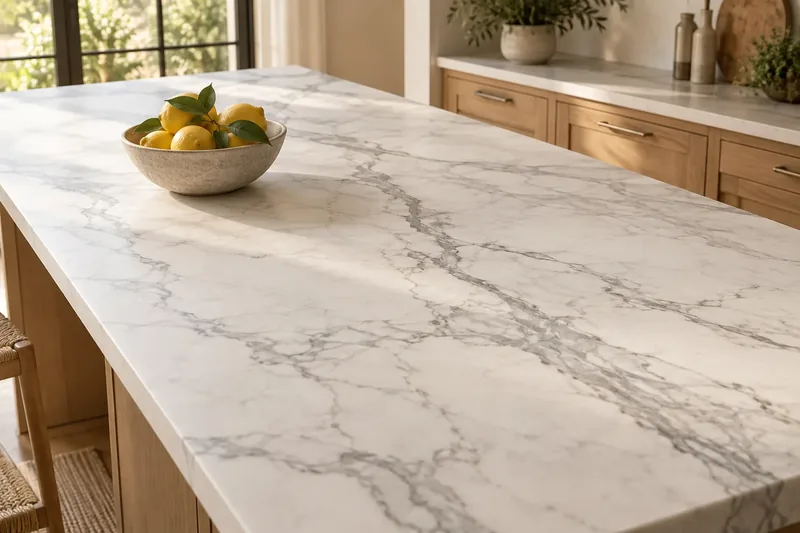
We put the joint away from the main sight line, off the sink and cooktop openings, and over a solid cabinet frame.

Temecula Custom Countertops provides seamless countertop joining & seam matching in Temecula, CA and across Riverside County. Long runs and L-shaped kitchens always need a joint, so we plan where it falls, line up the stone across it and close it so tightly that you have to hunt for it.
Get a free measure or a bid
A seam is not a flaw. It is the place where two pieces of stone meet because no slab is long enough to cover a big kitchen in one piece. What matters is where that joint lands, how closely the two faces match, and how well it is supported. Get those three right and the seam fades into the top.
Our crew decides seam locations with you at the template, matches the pattern in the shop and closes the joint on install day. We join stone for homes in Temecula, Fallbrook and French Valley, and for commercial counters that run long.
How we work
Homeowners get a free measure. Wineries, restaurants, offices and builders get a bid from their drawings.
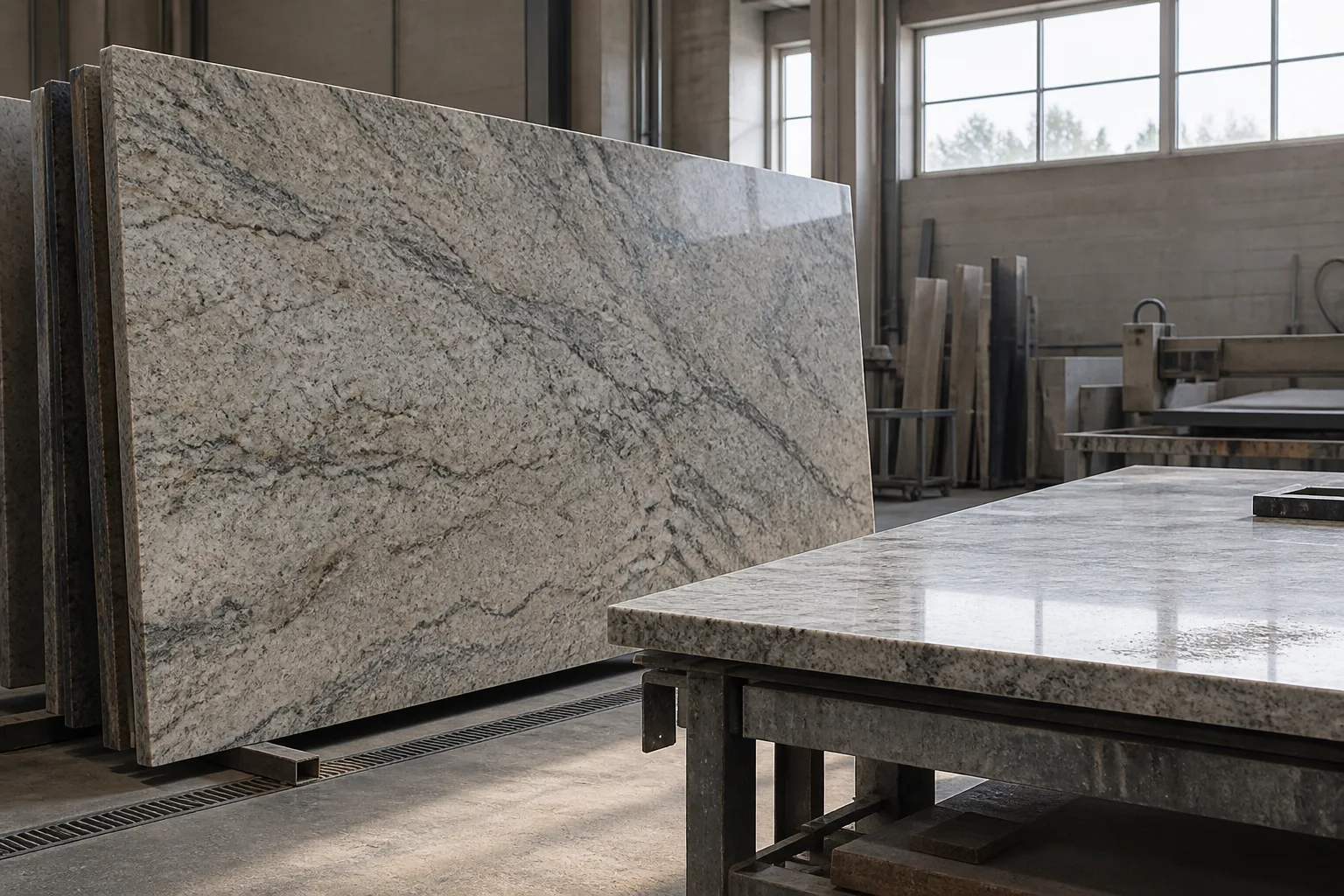
A countertop needs a seam whenever the run is longer than one piece of stone can be. Slabs are cut from a block and have fixed sizes, usually around ten feet in length, so a kitchen with a long wall, an L-shaped corner or a big island often needs a second piece. Stone also has to be carried through doorways and around corners, which limits how large a single piece can reasonably be.
An inside corner is the most common reason for a joint. A corner cut from one piece of stone would have a thin, weak point where the two arms meet, and it would waste a great deal of slab. Two straight pieces joined at the corner are stronger, cheaper and easier to set.
So the question is never whether to have a seam but how to make it good. That is craft, and it starts long before the stone is bonded.
A good seam is the sum of several small decisions, and every one is made on purpose. Skipping any of them is how you end up with a joint you can feel with a fingernail or see across the room. These are the four that matter most.
We put the joint away from the main sight line, off the sink and cooktop openings, and over a solid cabinet frame.
Pieces are laid out so veining continues across the joint instead of colliding head-on at it.
Edges are cut dead straight, dry-fitted, then pulled together with seam setters and bonded.
The two faces are brought flush so there is no ridge, then the joint is polished to match.
The best seam location is the one you will hardly ever look at. We choose it by standing in your kitchen at the template and walking through how you use the room. Where do you chop and mix? Where do people stand when they come in? Which view do you see from the table? The joint belongs outside those lines wherever the layout allows.
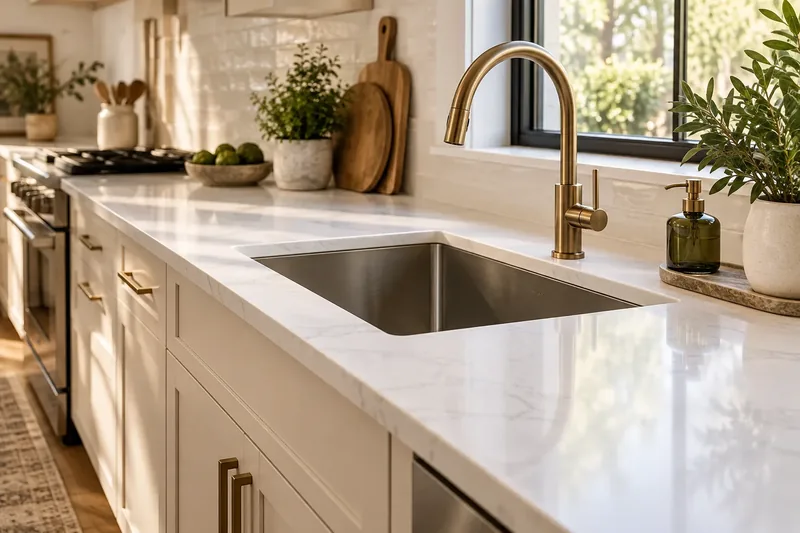
Some places are bad every time. A seam through the middle of a sink or cooktop opening is weak, because the cutout already removes stone. A seam over an unsupported span can flex, and a flexing joint cracks. A seam near the dishwasher sees steam and moisture that stress the adhesive.
We mark the proposed joints on the slab you chose, so you see where each one will fall against the veining before any cutting begins. If a slightly different spot looks better, we move it then, when it costs nothing, instead of after the stone is cut.
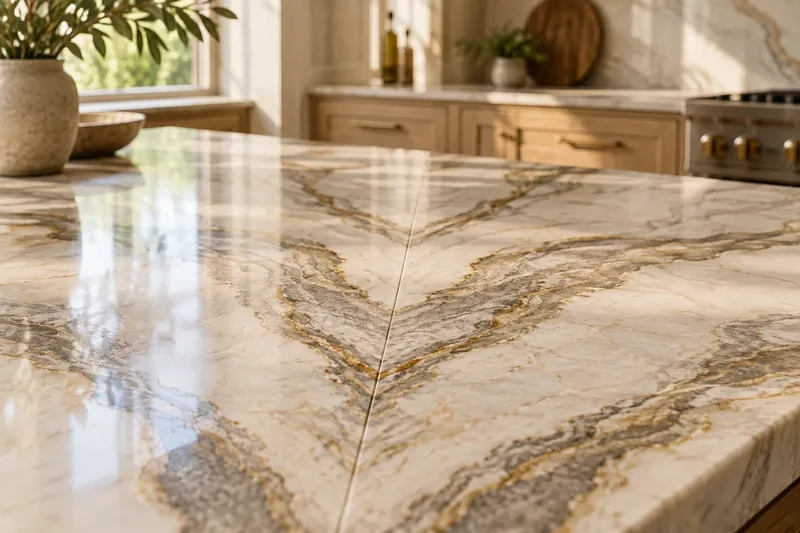
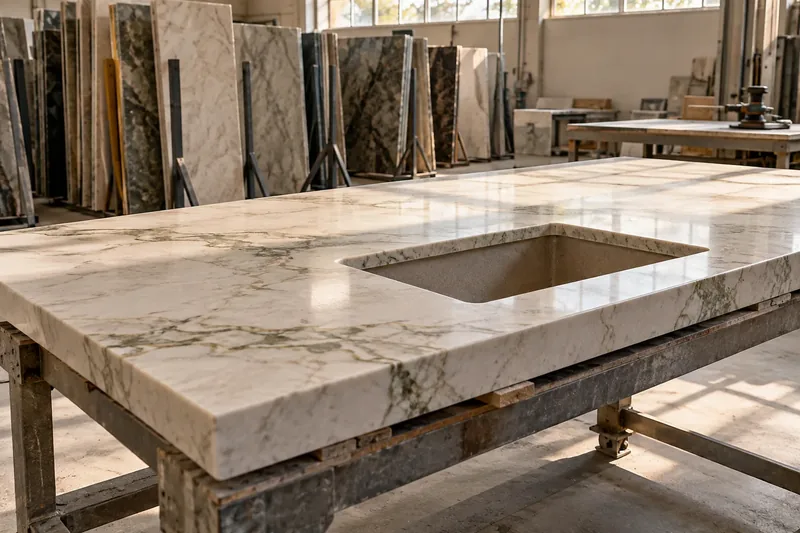
Stone with strong movement needs careful layout, because a dramatic vein that stops dead at a seam draws the eye straight to it. We solve that by choosing the order and direction of the pieces on the slab. When two pieces are cut side by side from the same area, the pattern can flow from one to the next with only a hairline between them.
Bookmatching goes a step further. Two neighbouring cuts from one block are opened like the pages of a book, so the veining mirrors across the joint. It looks deliberate and striking on an island, a waterfall panel or a full-height splash behind a cooktop, and it needs enough slab to yield both faces.
Temecula kitchens that open to bright patios and tall windows show a joint more clearly than dim rooms do, since strong light across a polished face picks up any step in the surface. We keep that in mind when we choose between a polished and a honed finish near the seam.
We also look at the shade of each piece in the room's own light, not just under shop lamps.
Closing a seam is a hands-on job done in a set order. The two mating edges were cut straight in the shop and dry-fitted there, so on site they should meet cleanly. We set the first piece, then the second, and check the cabinets are level underneath because a joint can only be as flat as the base it sits on.
The pieces are drawn together with suction or clamp-style seam setters. A thin bead of colour-matched adhesive, tinted to your particular stone, fills the line between them. We then adjust the two faces until they sit flush and let the adhesive cure before it is scraped and polished.
When it is done well, the joint is a hairline of the same colour as the surrounding stone, with no ridge to catch a cloth. You can ask to see it in raking light before we finish, which is the harshest test a seam can get.
Seams on a top we build are part of the installed price, so you do not pay extra for planning and matching on a new job. Work on joints that already exist is priced after we see them. The figures below are estimates only, and the written quote sets the final number.
What moves these numbers is the length of the seam, how much damage there is, how far the stone has moved, and whether the cabinets underneath are sound. Patching a joint over a crooked base only lasts a few months. We examine the base first and add any levelling to the quote when it is needed.
A well-made seam needs no special care. Wipe it like the rest of the top, and avoid setting a very hot pan across it, since heat stresses the adhesive line. Do not stand or sit on the stone near a joint, and do not lean on a long overhang.
If you notice a gap opening, a rough edge or a line that has turned a different colour, tell us early. Small seam problems are quick to fix, and a joint left to flex usually gets worse. Send a photo with the form and we will tell you what we think it needs.
The process
You see where every seam will land before any stone is cut.
Tell us the kitchen shape and the stone you like, or send a photo of a seam that needs work.
We choose each joint location with you in the room and draw it on the slab for your approval.
We lay out the pieces for the best veining match, then cut, edge and dry-fit them in the shop.
On install day we bond each seam, level it flush and polish it to match the finish.
Also from our shop
Questions
Not literally, but it can come very close. If the joint sits outside the line of sight, the veining carries across it and the adhesive is tinted to the stone, most visitors never find it.
Slabs only come so long, usually around ten feet. A longer run, or an L-shaped corner, has to be built from two or more pieces, and the joint is how they connect.
Out of the main sight line, away from the prep area and never through a sink or cooktop opening. We pick the spot with you at the template and mark it on the slab.
Quartz, because its pattern is consistent from piece to piece. Boldly veined natural stone can look wonderful across a joint, though it demands more planning on the slab.
Not when it is bonded well and rests on a solid frame. Weak joints almost always trace back to a sagging span or a crooked cabinet run, which is why we test the base before stone goes down.
Frequently. A gap, a crack or a dark line can often be cleaned out, filled with adhesive tinted to the stone and polished again. We inspect it first and tell you if the cause is underneath.
It mirrors the veining across the joint for a symmetrical pattern, which looks striking on an island or splash. It needs extra slab yield, so we confirm it is possible before you commit.
Book a free measure. We plan the seams with you in the room, and the written quote follows.
A free measure for homeowners, and a written bid from drawings for businesses and builders.
Licensed, bonded & insured · License #585047. Calls only, we do not receive text messages.