Outdoor kitchens
Sun, heat and weather all day, where UV stability counts.

Temecula Custom Countertops is Riverside County's trusted specialist in porcelain slab countertops in Temecula, CA, specializing in sintered stone, mitered edges and outdoor kitchen tops. We offer large-format porcelain and sintered stone surfaces for kitchens and patios.
Get a free measure or a bid
Or call (951) 466-2371. Calls only, we do not receive text messages.
Our team provides precise cutting and careful handling, delivering a modern countertop for homes and a hard-wearing countertop for both residential and commercial projects. We cut in our own shop, we lay out every seam before the first cut, and the same crew that templates sets the slab.
From a mitered edge that hides a thin profile to a support frame that carries a long span, our team handles every detail. Serving Temecula, French Valley and Temescal Valley, we match the slab, the edge and the support to where the top will live.
How we work
Homeowners get a free measure. Wineries, restaurants, offices and builders get a bid from their drawings.
Porcelain is a ceramic fired in a kiln at roughly 1,200 to 1,400 degrees Celsius. At that heat the body vitrifies, which gives it very low porosity and considerable hardness. Modern large-format porcelain is made in big thin sheets and is used for floors, cladding and, increasingly, countertops.
Sintered stone is a close relative. Brands such as Dekton and Neolith press and fire mineral raw materials under heat and pressure, so the slab is held together by heat rather than by resin, and it ends up practically non-porous. Dekton is sold in thicknesses from 8 mm up to 30 mm, with large slabs of about 3.2 by 1.4 metres. Neolith is offered from 3 mm to 20 mm, with 12 mm and 20 mm used for countertops.
For a buyer these are cousins, and we treat them as one family on this page: a thin, dense, hard slab with a printed or through-body pattern.
Porcelain countertops are still a newer choice than granite, so many owners have never touched one. We keep sample pieces to hand so you can feel the weight, the edge and the surface before you decide.
The reason porcelain is popular in Temecula is the climate. Summers are hot and dry, and a lot of owners use the patio as a second kitchen for most of the year. Most quartz is made with resins that can discolour in direct sun, which is why outdoor kitchens usually use granite or porcelain. Sintered stone is rated for high resistance to ultraviolet light, scratches, stains and thermal shock, and it is fireproof. That makes it a strong choice for an outdoor kitchen island, a barbecue top or a pool bar, where a top sits in the sun all afternoon. Indoors, the same hardness suits a busy family kitchen. It does not need sealing, and it takes a hot pan with less worry than most stone.
Sun, heat and weather all day, where UV stability counts.
Hard, stain-resistant and unsealed, with a modern, clean look.
Non-porous tops for sinks and vanities. Sun matters as much as heat. A patio top that is shaded in the morning and in full sun by three in the afternoon will expand and contract through the day, and a thin slab on a proper base copes with that better than one left unsupported.
A thin slab with a printed face has a different edge problem from a thick natural stone. Where the pattern is only on the surface, a rounded or bevelled edge cut into the slab shows the plain body beneath, so the edge choices are narrower than with quartz or granite.
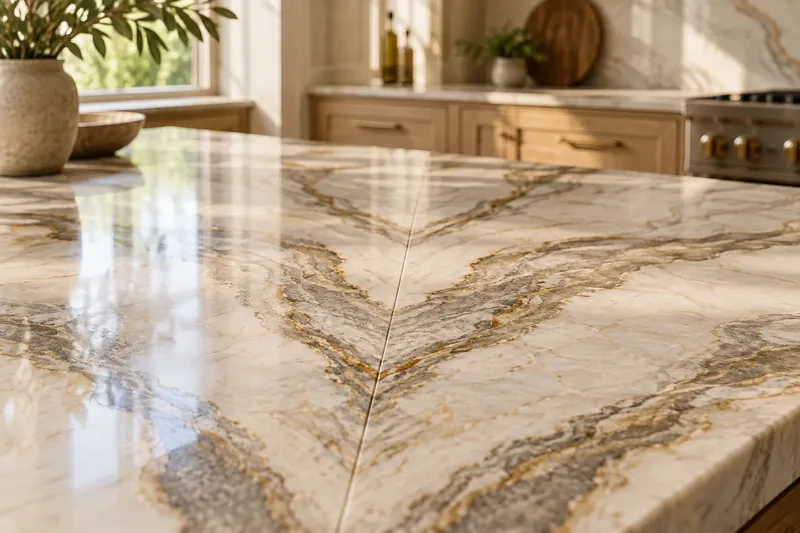
The usual answer is a mitered edge: two pieces are cut at an angle and met so the pattern wraps around the corner and the top looks thick. Some sintered stone is made with the colour running through the body, and that can take a profile cut more naturally, but you should ask about the exact product.
We show you the edge on a sample of your chosen slab before the order is placed, so you see how the pattern turns the corner. A built-up edge, where a strip is glued under the top, gives a thicker look at a lower weight.
Veining on a printed porcelain slab usually repeats, which helps with matching across a seam.
If the pattern is printed, check how it looks at the cut edge before you commit. A good sample shows you the face, the edge and the back, so there are no surprises when the first piece is mitered.
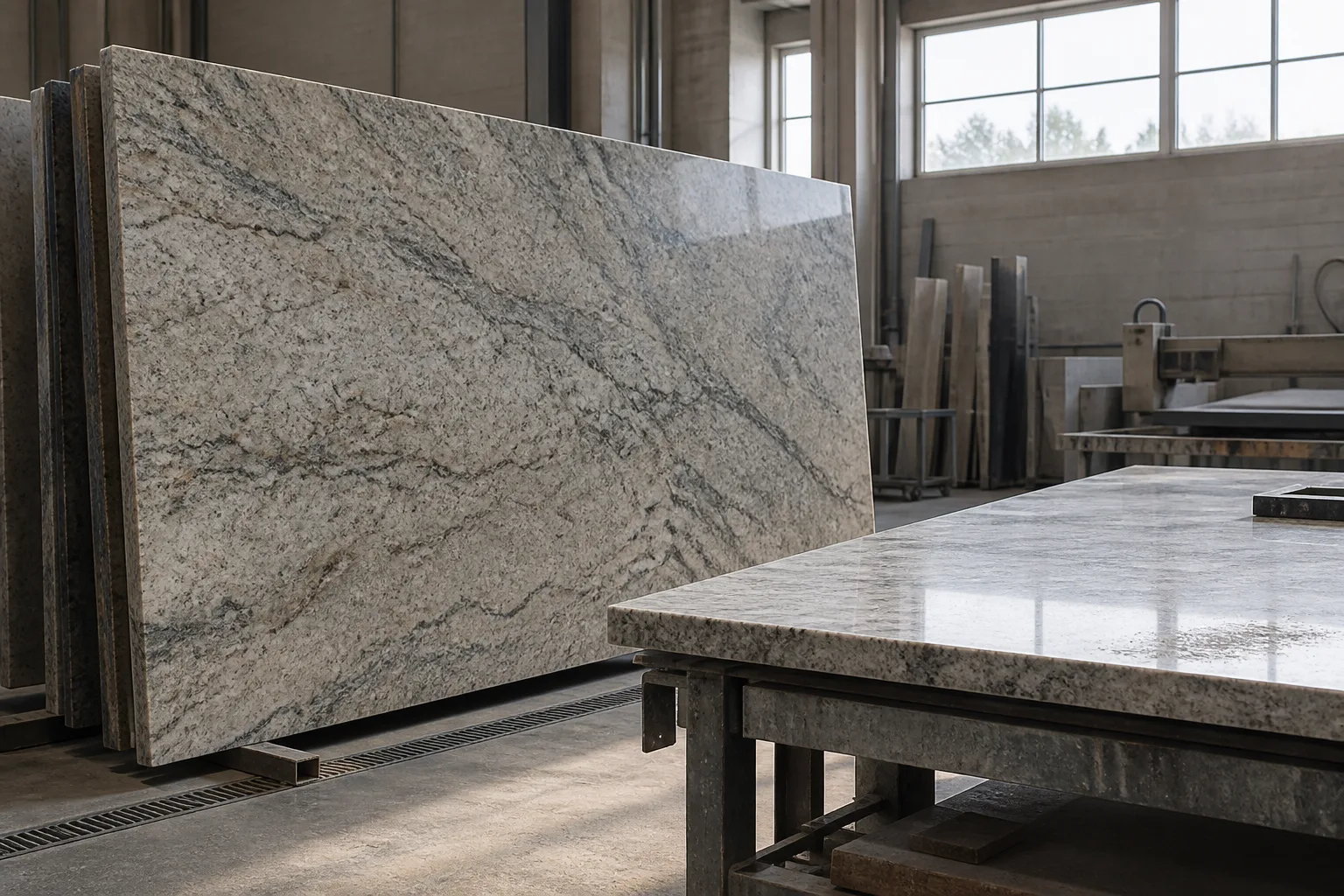
A thin, hard slab behaves differently from a thick one. It is strong in use and unforgiving in transit, because a long thin piece flexes when it is lifted flat and can crack at a corner. We carry and move slab on its edge, use the right clamps and keep the number of hands up on long pieces.
Cutting needs the right blades and a steady feed, because a hard, dense body chips if it is rushed. Inside corners are cut with a generous radius, since a sharp internal corner is where a crack starts. Cutouts for a sink or cooktop are rounded at the corners and given extra support around them.
A thin top also needs a proper base. Where the cabinet span is long or the unit is outdoors, we plan a plywood or steel support under it so the slab does not carry the load on its own. We glue the slab to the base, never rely on the cabinet alone, and we check that the cabinets are level before the stone is set.
All of this is done in the shop where we can control it, and the crew that cut the slab sets it.
We also plan the route in. A long thin slab has to get through gates, side yards and narrow hallways, and we look at every turn on the way at the measure so nothing is carried through a doorway it will not clear.
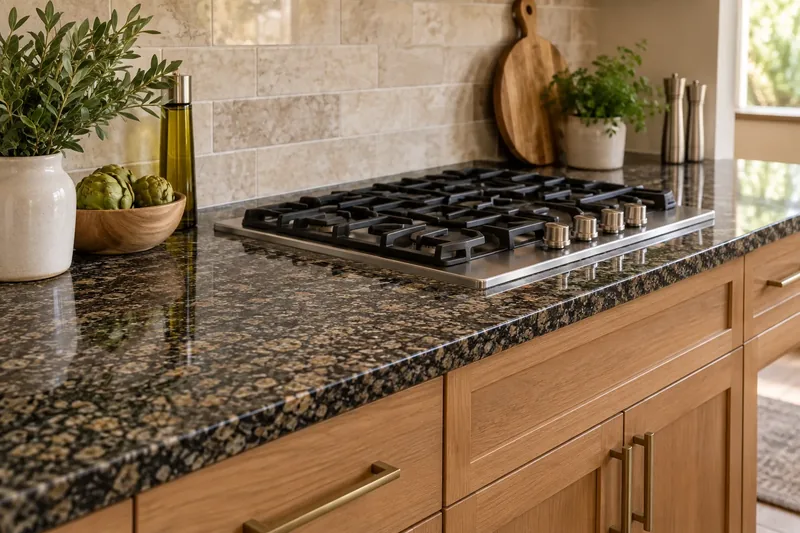
People often arrive with a short list of three materials, so a quick comparison helps.
Quartz is thicker with more edge choices and a warmer feel, but most of it is not made for direct sun. Porcelain wins outside.
Granite is natural, hard and heat tolerant, with a real stone pattern, and it needs a seal. Porcelain does not need sealing.
Marble looks wonderful and etches. Porcelain can copy a marble pattern without the etching, which matters in a valley with hard water. The trade-off is the edge and the handling. If you want a thick, softly rounded edge, quartz or granite will do it more easily. If you want a stain-proof, sun-proof surface with a crisp look, porcelain is hard to beat. If you are weighing porcelain for the patio and quartz for the kitchen, that is a common split, and we can match the colour family so the two rooms read as one house.
As a guide from industry ranges, porcelain and sintered stone countertops are typically estimated at roughly $70 to $160 per square foot installed. The final number moves with the brand and series, slab thickness, how many slabs the layout needs, edge profile and miters, seams, cutouts, backsplash height, support work for long spans or outdoor bases, tear-out and disposal, and access to the house.
Outdoor jobs add the base: if the barbecue island is built from block or steel, we measure once it is finished and plan the support to suit.
These figures are estimates and subject to change with the material and the scope. The written quote sets the final price. The free measure is where you get one.
Cost is the last part of the comparison, not the first. Porcelain is not always the cheapest slab, but it can save money on sealing, on replacing a faded outdoor top and on repairs.
We start at the free measure, where we template the cabinets or the finished base. You choose the slab and see a sample edge, we lay out the seams and miters on the slab, and you approve the drawing. Then the slab is cut in the shop and set. The install date is fixed at the measure and recorded on the quote.
On install day the slab arrives on edge and is set in one visit with the sink, the cooktop and the seams done together. Call to see samples and book your measure.
Bring a photo of the patio or the kitchen and the appliance model numbers, and we can tell you in one call whether porcelain is the right fit for the job.
The process
No stone is cut until you have seen the slab and signed off on where the seams go.
Tell us the room and the material you have in mind. Businesses and builders send drawings for a bid.
You choose the slab at the supplier, and we mark where each seam and cut will fall for your approval.
We measure on your installed cabinets, then cut, edge and polish the tops in the shop.
The same crew sets the tops, mounts the sink, closes the seams and cleans up before leaving.
Service area
Questions
It is hard, non-porous and stain resistant, and it suits both a busy kitchen and an outdoor one. Its limits are edge choices and careful handling.
They are close relatives. Sintered stone is pressed and fired under heat and pressure and is held together without resin.
Sintered stone is rated for high UV resistance, which is why it is chosen for outdoor kitchens.
No. The surface is practically non-porous, so it does not need a sealer.
A mitered edge is the most common because the pattern sits on the surface. We show you a sample edge before you order.
It handles heat well, but we still suggest a trivet near seams and cutouts.
It needs more care: thin slabs are moved on edge, cut with the right blades, and supported properly. That is why we do the cutting in the shop.
Yes, it is a common outdoor choice. We plan the support to suit the barbecue island base.
Call for the free measure. We template the base, show you slab samples and send a written quote.
A free measure for homeowners, and a written bid from drawings for businesses and builders.
Licensed, bonded & insured · License #585047. Calls only, we do not receive text messages.